
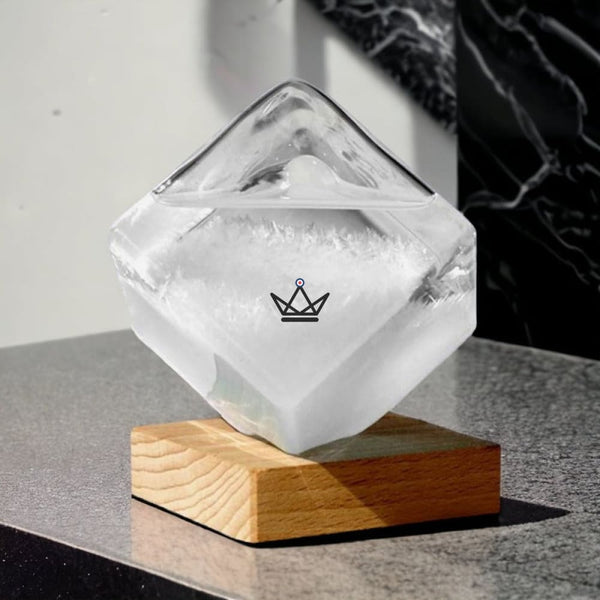


Glass cube storm glass barometer on wooden base - FROST
🚚 FREE DELIVERY
Tax included
Storm glass Wooden base The crystal barometer, or storm glass, takes on a resolutely geometric form here. A perfectly transparent glass cube rests in balance on one of its points, above a square light wood base. Inside, a clear or blue-tinted liquid allows white crystals to form, evoking snow, frost, or fine feathers by turns, evolving over the days according to the ambient temperature. GIVRE is available in two sizes, a small 6 cm cube for a desk or shelf and a large 8.5 cm cube for a more assertive presence, each in a transparent or blue version. Set on its point, the cube catches the light on its edges and gives the impression of floating. More than a weather object, it is a small crystallization experiment to observe daily, with no batteries or adjustments, and which never looks the same two days in a row, like a miniature winter landscape sitting on your desk.
Available models
The storm glass: a 19th-century curiosity
The storm glass became famous in the mid-19th century thanks to the British Admiral Robert FitzRoy, captain of the ship that took Charles Darwin around the world and a pioneer of weather forecasting. He distributed them to fishing ports and described how to read them: clear liquid in fair weather, starry crystals in cold weather, cloudy appearance before rain.
The traditional recipe combines camphor, ethanol, water, and salts (potassium nitrate, ammonium chloride). The solubility of camphor varies strongly with temperature: when it drops, a portion recrystallizes, forming needles, flakes, or deposits. The influence of atmospheric pressure remains debated by scientists. The storm glass is therefore primarily a decorative object and a lovely demonstration of crystallization, not a certified weather instrument.
Why you will love it
A miniature winter under glass
You forget it for a moment, then you return to it: in the morning, the liquid is clear; in the evening, after a drop in temperature, a fine forest of crystals has risen at the bottom of the cube. GIVRE lives up to its name (FROST). It sets a miniature winter on your desk, silent and changing, which reads like a landscape.
The choice of a cube is not trivial. While classic crystal barometers adopt a teardrop or globe shape, this one plays the card of pure geometry: six flat faces, sharp edges that catch the light, and that point on which everything rests. The light wood base, also square, mirrors the cube and adds a warm, natural note.
Transparent version for the elegance of white crystal on a clear background; blue version for a more graphic glacier effect. In both cases, an object that invites you to slow down and observe.
Setting up and observing your crystal barometer
Size comparison
| Criteria | Small 6 cm | Large 8.5 cm | Globe barometer (other model) |
|---|---|---|---|
| Shape | Cube on point | Cube on point | Sphere on arched support |
| Glass size | 6 cm | 8.5 cm | Not provided |
| Base | Light wood 6 × 6 cm | Light wood 8 × 8 cm | Dark wood or glass |
| Liquid | Transparent or blue | Transparent or blue | Transparent |
| Interior decor | Crystals only | Crystals only | Red rose, blue rose, or no flower |
| Ideal use | Desk, shelf, bedside table | Console, bookcase, living room | Living room, romantic gift |
Good to know: the formation of crystals depends primarily on the ambient temperature. In a room with a very stable temperature, the appearance will change little; near a window or in an entryway, the changes will be more marked. Traditional weather interpretations are a matter of tradition: enjoy the spectacle rather than relying on it to predict rain.
Tip: place the cube in front of a dark background or near a soft source of side light: the white crystals stand out clearly and the glass edges light up. Avoid windowsills in direct sunlight, which heats the liquid and dissolves the crystals.
Technical specifications
| Type | Decorative crystal barometer (storm glass) |
| Shape | Cube resting on a point |
| Material | Glass, light wood base |
| Small model | 6 cm cube, 6 × 6 cm base |
| Large model | 8.5 cm cube, 8 × 8 cm base |
| Liquid | Transparent or blue |
| Crystals | White, changing according to temperature |
| Packaging | 12 × 12 × 18.5 cm box (based on photo) |
| Large model weight | Approximately 700 g packaged (based on photo) |
| Power supply | None |
| Recommended age | 14 years and older (supplier) |
Precautions: glass object containing a liquid: handle by the base, do not open, and do not shake. Not suitable for children under 14 years old; keep out of reach of young children and animals. The liquid must not be ingested: in case of breakage, collect the pieces carefully, wipe up the liquid with a paper towel, and ventilate the room.
A poetic gift idea
GIVRE is a gift that intrigues and lasts: for a birthday, Christmas, retirement, or simply to thank a curious colleague. Lovers of weather, sailing, and maritime history will find the legacy of Admiral FitzRoy; home decor enthusiasts, a refined object that changes every day.
Find other instruments and curiosities in our Weather & Time section, including a globe-shaped crystal barometer, or browse the experiments in our Minerals & Chemistry section and the entire Scientific Objects Lab.
Frequently asked questions
How does a crystal barometer work?
The crystal barometer, or storm glass, contains a liquid in which a substance is dissolved. In the traditional recipe, this is camphor mixed with ethanol, water, and salts. The solubility of this mixture varies with temperature: when it drops, part of the substance can no longer remain dissolved and forms visible crystals, in flakes, needles, or stars; when it rises, they dissolve again. The result is a changing landscape that reflects the thermal variations of the room. The exact composition of the liquid in this model is not disclosed by the manufacturer.
Can it really predict the weather?
To be honest: the storm glass is primarily a decorative object and a lovely demonstration of crystallization. In the 19th century, Admiral FitzRoy proposed a guide for reading it: clear liquid in fair weather, cloudy before rain, starry crystals in cold weather. Modern studies show that temperature is the primary factor; the effect of atmospheric pressure remains debated. It is therefore not a certified weather instrument. On the other hand, observing its crystals through the seasons remains a pleasure and a beautiful gateway to chemistry and the history of meteorology.
What is the difference between the small and large models?
Both models share the same principle and silhouette: a glass cube set on a point above a square light wood base. The small model measures 6 cm on each side and rests on a 6 × 6 cm base: it easily fits on a desk, bedside table, or crowded shelf. The large model measures 8.5 cm on an 8 × 8 cm base: its larger volume of liquid offers more spectacular crystal formations and a more assertive presence on a console or in a bookcase. Each exists in transparent or blue versions.
Why do the crystals seem agitated upon receipt?
This is perfectly normal. During transport, the barometer undergoes significant shaking and temperature variations: the crystals break, mix into the liquid, or dissolve, and the contents may appear cloudy or disordered. Simply leave the object at rest, away from sunlight and heat sources, for several days. The crystals will settle and then gradually reform according to the room temperature. Avoid shaking it to speed up the process: patience is your best ally here, and the crystal landscape will always reconstitute itself.
Where should I place the barometer for a beautiful effect?
Choose a stable and level surface, protected from impacts, direct sunlight, and heat sources like radiators or electronic devices. To see the crystals evolve, prefer a room where the temperature naturally varies between day and night: an entryway, a desk near a window (without direct sun), a bedroom. In a room with a very constant temperature, the appearance will change less. As for staging, a dark background or soft side light makes the white of the crystals and the edges of the cube stand out. Avoid exposed edges where it risks being bumped.
Transparent or blue: which to choose?
The transparent version offers the most classic and elegant look: the white crystals stand out against a clear liquid, like frost on a window. It fits anywhere and lets light pass through the cube. The blue version offers a more graphic effect, evoking a glacier or polar water: the white crystals stand out against the bluish tint, and the object becomes a splash of color in a neutral decor. Both work according to the same principle. For a sober desk or a universal gift, the transparent; for a more colorful interior, the blue.
How do I maintain it?
The crystal barometer requires virtually no maintenance. It works without batteries or settings, and the cube is sealed: never try to open it. Simply dust the glass with a soft, dry cloth or a slightly damp one, holding the object by the base without pressing on the point. The wooden base can be cleaned with a dry cloth; avoid excess water and household cleaning products. To move it, lift the whole piece with both hands, by the base. Keep it away from intense heat sources, which could dissolve the crystals long-term or weaken the glass.
