
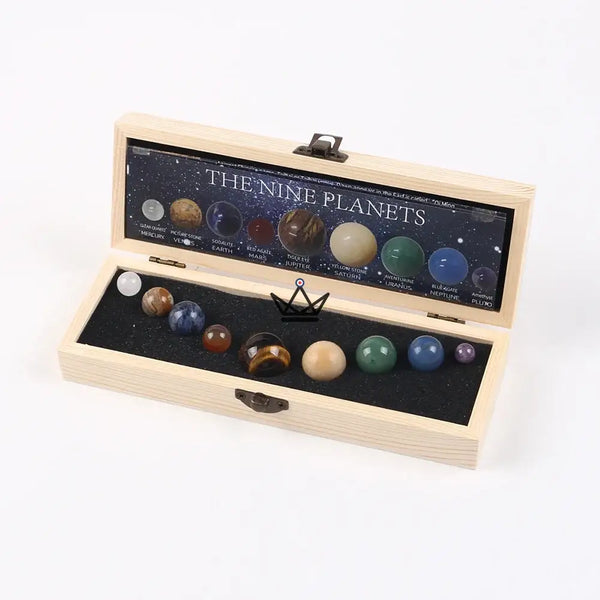


Natural stone solar system, 9 spheres in a wooden box — SIDÉRAL
Tax included
In the box
- 9 natural stone spheres
- Wooden box with clasp
Everything you need to know
Natural stones 9 spheres Holding the solar system in the palm of your hand: that is the promise of SIDÉRAL. This natural stone solar system brings together nine spheres, from Mercury to Pluto, each carved from a stone chosen to evoke the color of its celestial body: blue sodalite for Earth, red agate for Mars, tiger's eye with golden reflections for Jupiter, and purple amethyst for Pluto. The spheres measure from 1 to 2.5 cm in diameter and rest side by side in a light wood box with a metal clasp, featuring a black interior with nine aligned compartments. On the lid, an illustrated label presents the nine celestial bodies and serves as a cheat sheet for putting them back in order. Halfway between a mineral collection and an astronomy model, SIDÉRAL is a scientific object that is meant to be looked at, handled, and shared. Placed on a desk, a shelf, or a bedside table, it transforms a science lesson into a decorative piece, making it a scientific gift appreciated by the curious of all ages, from star-gazers to mineral enthusiasts.
Nine celestial bodies, nine stones
| Celestial body | Stone | Diameter | What evokes it |
|---|---|---|---|
| Mercury | Clear quartz | 1.2 cm | A limpid stone for the planet closest to the Sun |
| Venus | Picture jasper | 1.6 cm | Nuanced patterns that recall its thick cloud cover |
| Earth | Sodalite | 1.8 cm | A deep blue veined with white, like the oceans and clouds |
| Mars | Red agate | 1.4 cm | The hue of the red planet |
| Jupiter | Tiger's eye | 2.5 cm | Golden and brown bands that echo its atmosphere |
| Saturn | So-called "yellow jade" | 2.2 cm | The pale yellow of the ringed giant |
| Uranus | Aventurine | 2 cm | A green hue that recalls its blue-green color |
| Neptune | Blue agate | 1.8 cm | The blue of the most distant planet |
| Pluto | Amethyst | 1 cm | The smallest sphere for the box's dwarf planet |
Highlights
Natural stones
From quartz to amethyst: a mineral family
Most of the SIDÉRAL stones belong to the vast quartz family, the most common mineral in the Earth's crust. Clear quartz is its limpid form; amethyst is its purple variety; aventurine owes its sparkles to fine inclusions; tiger's eye displays the silky, shifting reflections known as chatoyancy. Agates and jasper are forms of microcrystalline quartz: the former are often banded, the latter opaque, and the so-called "picture" jasper features patterns that suggest distant horizons. Sodalite is a distinct mineral, recognizable by its deep blue traversed by white veins.
Because they are natural stones, no sphere is a copy of another: the density of the veins, the intensity of the color, or the position of an inclusion change from one piece to another. The photos therefore present a typical box; the one you receive will have its own nuances. This is precisely what makes the charm of a stone solar system: a scientific object that retains something of the geology from which it originates.
The sky in a box
Nine worlds in the palm of your hand
Since antiquity, planets have been observed as "wandering stars" moving among the constellations. SIDÉRAL offers another way to approach them: through touch. One can pick up the tiger's eye sphere of Jupiter, the largest in the box, then the tiny amethyst of Pluto, and measure in one gesture what separates the gas giants from the small rocky worlds.
With the box open, the nine spheres aligned on the black background form a line of colors that evokes a model of the solar system. Closed, it becomes a simple light wood box to store on a shelf, among astronomy books or travel souvenirs.
Pluto has kept its place: long counted among the planets, it was reclassified as a dwarf planet in 2006. An opportunity to explain that science, too, revises its classifications.
User guide
Discover the solar system in four steps
Things to know before buying
Sizes not representative of true scale: the diameters of the spheres (1 to 2.5 cm) generally follow the order of magnitude of the celestial bodies, from largest to smallest, but not their proportions. At true scale, Jupiter would be about eleven times wider than Earth. The spacing between the compartments also does not represent the distances between the planets. The Sun is not part of the nine spheres.
Maintenance advice: to restore the shine of the spheres, simply wipe them with a soft, dry cloth. Avoid household products and impacts: a natural stone can chip if it falls on a hard floor. Place each sphere back in its compartment after handling, with the box closed, so that none go missing.
Small objects: the smallest spheres are 1 to 1.4 cm in diameter and can be swallowed. Keep the box out of reach of young children and let older ones explore it under adult supervision. The spheres are not toys to be thrown or put in the mouth.
Specifications
| Type | Natural stone solar system, educational decoration |
| Number of spheres | 9 (eight planets and Pluto) |
| Diameters | From 1 cm (Pluto) to 2.5 cm (Jupiter) |
| Stones | Clear quartz, picture jasper, sodalite, red agate, tiger's eye, so-called "yellow jade," aventurine, blue agate, amethyst |
| Scale | Sizes not representative of real scale |
| Box | Light wood, metal clasp |
| Interior | Black, 9 aligned compartments |
| Lid | Illustrated label of the 9 celestial bodies |
| Appearance | Shades and veining vary from one piece to another |
| Contents | 9 natural stone spheres, wooden box with clasp |
A scientific gift idea
A gift for those curious about the sky
A birthday for a child passionate about space, Christmas for a mineral collector, a retirement party for a colleague who gazes at the stars: SIDÉRAL is appealing because it is both beautiful and educational. Its wooden box with a clasp gives it the look of a well-crafted gift, ready to be placed under the tree.
To extend the journey, pair it with another astronomy object or a collector's stone. Also find all our ideas in our selections for Christmas gifts, birthday gift ideas, and retirement gifts.
