


Magical crystal garden in a vial, chemistry experiment — GERMINA
Tax included
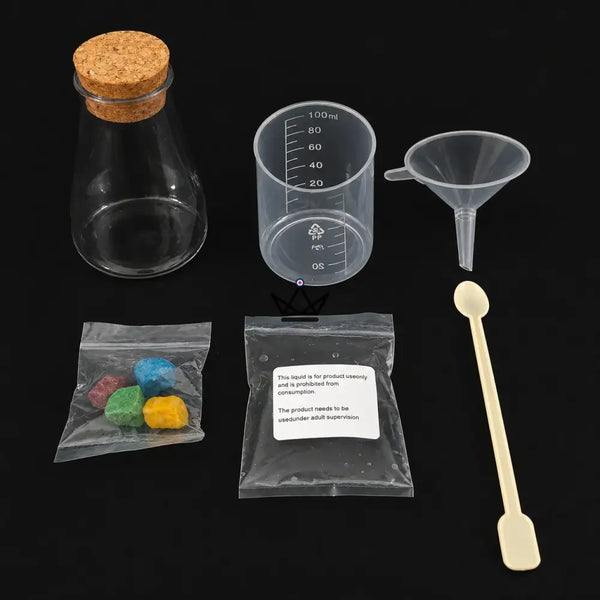
In the box
- Transparent vial with cork stopper
- Graduated measuring cup
- Funnel
- Spatula-spoon
- Bag of colored crystal growing stones
- Bag of crystal growing solution
- Duo version: 2 vials (conical and round) and 2 complete kits
Everything you need to know
Chemistry experiment Complete kit Pour, mix, sow, then watch the chemistry take shape. The GERMINA magic crystal garden transforms a simple transparent flask into a small living laboratory: within a few hours, colored filaments rise from the bottom to draw a mineral forest suspended in the liquid. The principle is that of a chemical garden, a chemistry experiment known for centuries, which relies on a sodium silicate solution and colored growth stones. Each kit contains everything needed to perform it at home: the flask with its cork stopper, a graduated measuring cup, a funnel, a spatula-spoon, a sachet of growth solution, and a sachet of stones. Three versions are available: the conical flask, the round flask, or the Duo, which combines both shapes and two complete kits to compare results or conduct the experiment together. A crystal creation that is easy to do at home, sparking the scientific curiosity of children—under adult supervision—as well as adults.
Kit highlights
Sodium silicate
Sodium silicate: the chemists' "water glass"
Sodium silicate is a compound of silica and sodium that has long been nicknamed "water glass": dissolved in water, it forms a clear, slightly viscous solution. It is what makes up the growth solution in the GERMINA kit. The chemical garden is an experiment described as early as the 17th century by European alchemists and chemists, who were already marveling at seeing plant-like forms emerge from a mineral mixture.
The phenomenon is not crystal growth in the strict sense: upon contact with the solution, each growth stone becomes surrounded by a thin mineral membrane. Water crosses this wall via osmosis, pressure builds up, the membrane gives way upwards, and a new portion of tube is immediately formed. This cycle repeats, drawing the colored filaments that rise within the flask.
A cabinet curiosity
Chemistry that mimics life
In the cabinets of curiosities of old, nothing was more fascinating than an object capable of blurring the line between the mineral and the living. The chemical garden belongs to this family: stems that rise, branch out, and become colored, like algae or coral, even though no seeds were sown.
GERMINA revives this tradition with the sobriety of laboratory glassware. The transparent flask serves as a display case, the cork stopper recalls the vials of ancient workbenches, and the spectacle unfolds slowly, at its own pace, without screens or batteries.
You prepare the solution, you sow the stones, then you return periodically to observe the garden: it is this rewarded patience that makes the experiment so charming.
Successfully growing your crystal garden
The experiment in four steps
Which version to choose?
| Criteria | Conical flask | Round flask | Conical + round duo |
|---|---|---|---|
| Shape | Wide base, narrow neck | Rounded body, narrow neck | Both shapes |
| Flasks | 1 | 1 | 2 |
| Complete kits | 1 | 1 | 2 |
| Experiments | One garden | One garden | Two gardens to compare |
| Ideal for | A first discovery | A softer silhouette | Siblings, parent-child duo |
Good to know
Contents of each kit: a transparent flask with its cork stopper, a graduated measuring cup, a funnel, a spatula-spoon, a sachet of colored growth stones, and a sachet of growth solution. The Duo version contains two complete kits, one with the conical flask and one with the round flask. Water is not provided. The hues and shapes of the filaments vary from one experiment to the next: each garden is unique.
Workshop tip: use warm water rather than hot, and be sure to respect the 100 ml line on the cup. Place the flask in its permanent spot before sowing the stones: once growth has started, it is best not to move or shake it to keep the filaments perfectly straight. Place it in front of a window or lamp to enjoy the colors through transparency.
Precautions for use: sodium silicate is irritating to the eyes. Avoid any contact with the eyes, and in case of contact, rinse thoroughly with clean water. Do not ingest the solution or the growth stones. Wash your hands after handling. For children, the experiment must always be performed under adult supervision. Keep the kit, the prepared solution, and the flask out of reach of young children. Do not use the kit's utensils for food purposes.
Specifications
| Type | Chemistry experiment kit, flask chemical garden |
| Principle | Growth of colored filaments in a sodium silicate solution |
| Versions | 3: conical flask, round flask, conical + round Duo |
| Items per kit | 6: flask with cork, measuring cup, funnel, spatula-spoon, 2 sachets |
| Number of flasks | 1 (conical or round) or 2 (Duo) |
| Flask | Transparent plastic, cork stopper |
| Dosage | Warm water up to the 100 ml line of the cup |
| Growth time | A few hours |
| To be provided | Warm water (not provided) |
| Use | Children under adult supervision, teenagers, curious adults |
| Purpose | At-home scientific experiment, scientific decorative object |
A scientific gift idea
Give the pleasure of discovery
For a birthday or under the Christmas tree, GERMINA is one of those scientific gifts that you open with curiosity and want to try right away. The experiment is prepared in a few minutes, then the garden reveals itself over the hours: enough to extend the moment long after the package is opened.
The Duo version can be shared between siblings or between a parent and child, each with their own flask. To assemble a real lab corner, pair it with a test tube rack or a collectible mineral, also available in our birthday gift ideas.
