


Glass Franklin's boiling point, blue liquid that boils in your hand — HEAT
Tax included
In the box
- 1 glass hand boiler
Everything you need to know
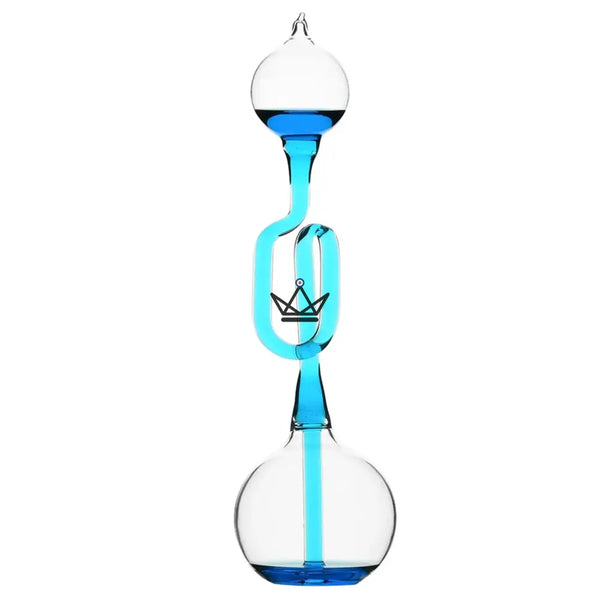
Physics experiment Glass Simply take it in your palm for the magic to happen. The CALORIS hand boiler, also known as a Franklin boiler or love thermometer, is a glass scientific object 16.5 cm tall that turns the heat from your fingers into a spectacle. Two transparent bulbs, a small one at the top and a larger one at the bottom, are connected by a double-loop tube in which a blue liquid circulates. Place your hand on the bottom bulb: the liquid climbs the loop, reaches the top bulb, and starts to bubble, looking as if it is boiling, even though it remains barely lukewarm. Then hold the top bulb and the movement reverses. Behind the effect lies a real lesson in vapor pressure physics, visible to the naked eye and without any batteries. Fragile and delicate, this scientific gift, recommended for ages 14 and up, will find its place on a desk, a shelf, or in the cabinet of a curiosity collector.
Why it is so intriguing
Glass, the material of the experiment
Glass: seeing physics through matter
If glass is the preferred material for demonstration instruments, it is first and foremost for its transparency: it allows you to see every stage of the phenomenon, the rise of the liquid in the tube, its passage through the loops, and finally the arrival of the bubbles in the upper bulb. Nothing is hidden, everything is clear.
Glass is also an impermeable and inert material: it keeps the liquid locked in a closed circuit and does not react with it. On the other hand, it remains fragile. The walls of the bulbs and the double-loop tube should be handled gently, preferably over a soft surface, and stored away from impacts and falls.
How the hand boiler works
The heat that moves the liquid
Inside the glass, CALORIS contains a volatile liquid colored blue. Volatile means that it easily changes from a liquid to a vapor state, even at room temperature. Above the liquid, the empty space is filled with its own vapor, the pressure of which depends directly on the temperature.
When you close your hand around the bottom bulb, you warm it slightly. The vapor pressure increases on that side and pushes the liquid upward, through the double-loop tube, to the top bulb. Once the liquid has left the bottom bulb, the vapor itself rushes into the tube and rises in bubbles through the liquid: it is this bubbling that creates the illusion of boiling.
The liquid does not heat up like in a pot. It does not boil in the usual sense: it simply moves from the warmer zone to the cooler one. Hold the top bulb, and the temperature difference is reversed, as is the path of the liquid.
Making CALORIS boil in four steps
What happens according to your grip
| Situation | What you observe | Why |
|---|---|---|
| Hand on bottom bulb | Liquid rises into the loop and bubbles at the top | The vapor, heated at the bottom, pushes the liquid toward the cooler bulb |
| Hand on top bulb | The liquid moves back down to the large bulb | The hot zone moves to the top: the pressure direction changes |
| Object left at rest | The liquid gradually gathers at the bottom | Without a temperature difference, gravity takes over |
| Cold hands | Slower, or even subtle reaction | The temperature difference between the hand and the glass is lower |
Good to know: the hand boiler does not measure temperature and does not tell you anything about your feelings, despite its nickname, the "love thermometer." It reacts to the temperature difference between your hand and the glass: the warmer the hand is compared to the room, the faster and more spectacular the phenomenon.
Tip for a successful demonstration: rub your hands together for a few seconds before holding the bottom bulb, or blow gently on your palms. In a cool room, the effect is often clearer. For a group demonstration, pass the object from hand to hand: everyone gets a slightly different result, which inevitably sparks conversation.
Specifications
| Type | Hand boiler |
| Material | Glass |
| Height | 16.5 cm |
| Width | 5 cm |
| Number of bulbs | 2 (a small one at the top, a large one at the bottom) |
| Connecting tube | 2 loops |
| Contents | Blue-colored volatile liquid, closed circuit |
| Operation | Heat of the hand, no batteries or power needed |
| Recommended age | 14 years and older |
| Colors | Transparent glass, blue liquid |
| Use | Scientific demonstration and decorative object |
Fragile glass object: handle CALORIS with care, without squeezing or shaking it, and place it away from impacts and falls. Never heat it with anything other than your hand (flame, radiator, hot water, direct sunlight) and do not try to open it. In case of breakage, collect the pieces carefully and avoid any skin, eye, or mouth contact with the liquid. Recommended for ages 14 and up; keep out of reach of young children.
A scientific gift that gets a reaction
For the curious of all ages
Christmas, birthdays, a small gift for a colleague passionate about science or a physics teacher: CALORIS is one of those gifts that you try out as soon as you open it and that everyone wants to hold in turn. It appeals just as much to curious teenagers, from age 14, as it does to adults who love desk objects with a story to tell.
To extend the exploration of heat and motion, pair it with the CASTOR Stirling engine, which also transforms temperature differences into movement, or the AURORE crystal barometer. Shipping is free.
