
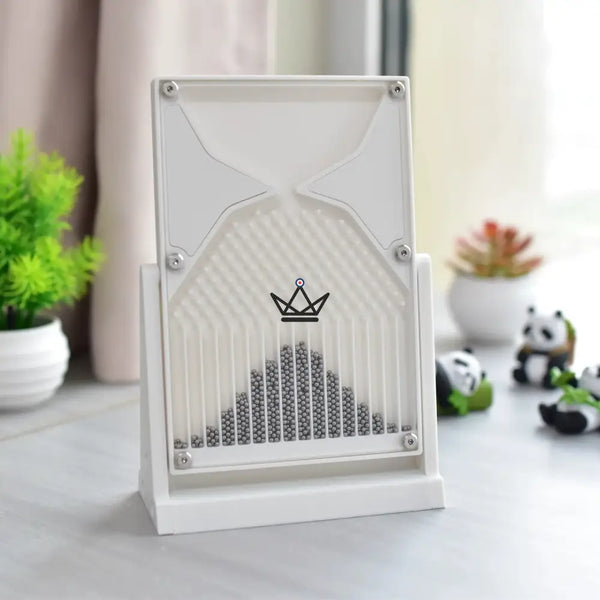


Galton board normal distribution, mathematical desk object - QUINCUNX
🚚 FREE DELIVERY
Tax included
Probability Desk accessory Flip it, and randomness falls into order before your eyes. The Galton board QUINCUNX drops hundreds of small black beads through rows of pegs: at each obstacle, every bead moves left or right at random. Yet, once they reach the bottom, they pile up in columns, tracing a shape that is almost always identical: the famous bell curve of the normal distribution. The vertical frame rests on a desk; the transparent plate allows you to see the entire journey, from the hourglass-shaped reservoir to the columns. Three versions are available: a black frame with the Gaussian curve printed in gold, a white frame with the curve printed in red, or a white frame without a curve, to let the beads speak for themselves. A demonstration piece as much as a soothing desk sculpture, the Galton board fascinates mathematicians, data scientists, teachers, and anyone who loves to see an abstract idea take shape before their eyes.
The three versions
From bead to central limit theorem
The British scientist Sir Francis Galton conceived this device in the 1870s and described it in his work Natural Inheritance in 1889. He called it the quincunx, after the staggered arrangement of the nails. Its goal: to show that a multitude of small, random, and independent events produces, collectively, a perfectly predictable distribution.
Each bead encounters several rows of pegs in succession and, each time, has about a 50/50 chance of going left or right. To end up on the far right, it would have to fall on the same side at every row, which is very improbable; the paths leading to the center, however, are extremely numerous. The resulting distribution follows a binomial distribution which, with many rows and beads, approximates the normal distribution. It is a concrete illustration of the central limit theorem, one of the pillars of modern statistics.
Galton, a cousin of Charles Darwin, was interested in the variation of characteristics in populations, such as the height of individuals. The quincunx served him to show how small, multiple, and independent causes produce this famous bell-shaped distribution found everywhere in nature and in data.
Why you will love it
The hidden order in randomness
Taken one by one, a bead is unpredictable: no one can say which column it will end up in. Taken by the hundreds, they obey a law of almost disturbing regularity. This tension between the unpredictable individual and the predictable collective is at the heart of statistics, gas physics, surveys, insurance, and data analysis.
Galton saw it as a spectacle of rare beauty. More than a century later, the effect remains intact. On a desk, the board becomes a companion for reflection: you turn it at the start of a meeting, while a file is loading, or simply to give yourself a minute of calm. The rustling of the beads, the bell gradually forming, the symmetry that always ends up asserting itself: there is a lesson in patience here, and a small demonstration that the world, even if seemingly chaotic, keeps a shape.
Usage in 4 steps
Which version to choose?
| Criteria | Black, gold curve | White, red curve | White, no curve |
|---|---|---|---|
| Frame | Black | White | White |
| Printed Gaussian curve | Yes, gold | Yes, red | No |
| Theory / experience reading | Yes, elegant contrast | Yes, highly legible | Open, no reference |
| Atmosphere | Executive office, dark interior | Classroom, bright office | Minimalist interior |
| Beads | Black | Black | Black |
| Principle | Identical: staggered pegs, hourglass reservoir, flipping |
Good to know: the resulting bell is never perfectly identical from one flip to the next. One column may stick out a little, another remain slightly behind: these are fluctuations of randomness, also predicted by theory. The more beads there are, the closer the shape gets to the ideal curve. Other objects to awaken your logical mind await in our puzzles and desk collection.
Tip: flip the board slowly and wait for all the beads to return to the reservoir before turning it back over: the descent will be more regular. If a few beads get stuck between two pegs, gently tap the side of the frame with the tip of your finger.
Educational idea: ask your students or your children to bet on the fullest column before flipping the board. The center almost always wins, and it is the ideal starting point to talk about probability.
Technical characteristics
| Type | Demonstration Galton board (quincunx) |
| Principle | Binomial distribution tending towards the normal distribution |
| Format | Vertical desktop frame |
| Plate | Transparent, staggered rows of pegs |
| Reservoir | Hourglass-shaped |
| Beads | Several hundred small black beads |
| Versions | Black gold curve, white red curve, white no curve |
| Prints | English text on the plate |
| Operation | By gravity, by flipping the board |
| Power | None |
| Dimensions | Not communicated |
| Weight and exact number of beads | Not communicated |
Precautions: the board contains very small beads. If the plate breaks, they could escape and be swallowed: not suitable for children under 3 years old, and use by young children must be under adult supervision. Do not drop the board, do not shake it violently, and do not attempt to open it.
A gift for rational minds
For a mathematics teacher, a statistician, an actuary, an engineer, a data scientist, or a recent graduate, the Galton board is a gift that makes sense: it celebrates their discipline in an elegant and fun way. It also beautifully marks a retirement, a thesis defense, or a promotion.
In a living room, on a bookshelf, or in an entryway, it also stands out as an intriguing decorative object that guests cannot help but flip over. Combine it with other pieces from the Lab, our world of scientific objects, to compose a desk that makes you want to think.
Frequently Asked Questions
What is a Galton board?
The Galton board, also called a quincunx, is a device conceived by the British scientist Sir Francis Galton in the 1870s and described in 1889. It consists of a vertical plate fitted with staggered rows of pegs, a bead reservoir, and receiving columns. As they fall, each bead bounces randomly to the left or right off each peg. Once all the beads have arrived, their distribution in the columns forms a bell curve, characteristic of the normal distribution. It is one of the most telling demonstrations of the link between individual randomness and collective regularity.
Why do the beads form a bell curve?
At each peg, a bead has about a 50/50 chance of going left or right. To end up in an extreme column, it would have to fall on the same side at every row, which happens very rarely. The central columns, on the other hand, can be reached by a very large number of different paths, mixtures of lefts and rights. This is why they fill up more. Mathematically, the distribution follows a binomial distribution, which approaches the normal distribution as the number of rows and beads increases. It is a concrete illustration of the central limit theorem.
How to restart the experiment?
Simply flip the board. Rotate it gently so that all the beads return to the hourglass-shaped reservoir, wait a few seconds for the last ones to go back up, then place it back in position on a flat surface. The beads then flow through the pegs again and the bell reforms in the columns. The operation can be repeated at will, without batteries or settings: only gravity is at work. If a few beads remain blocked, tap the side of the frame slightly; however, avoid shaking the board, which would distort the descent.
What is the difference between the three versions?
The principle and operation are identical; only the aesthetics change. The black with gold curve version offers a refined look, ideal for an executive office or dark interior. The white with red curve version allows for an immediate comparison between the actual distribution of the beads and the theoretical printed curve, making it an excellent teaching aid. The white without curve version focuses on simplicity: no indication guides the eye; it is the beads alone that reveal the shape. In all three cases, the beads are black and English text is printed on the plate.
Is the resulting curve always perfect?
No, and that is the whole point of the experiment. The general bell shape returns with every flip, but the details vary: one column might stick out slightly, another stay a bit behind, the curve might seem slightly shifted. These deviations are the random fluctuations, also predicted by probability theory. The greater the number of beads, the closer the distribution gets to the ideal curve. Comparing several successive descents is, in fact, an excellent way to understand the difference between a theoretical law and a real sample, an essential notion in statistics.
Is it suitable for educational use?
Absolutely. The Galton board is a classic in probability and statistics courses, from middle school to university. It allows for a visual approach to randomness, equiprobability, the binomial distribution, the normal distribution, mean, and dispersion. Before flipping it, you can ask students to predict the fullest column, then confront their intuitions with the result. The version with the printed curve facilitates comparison with the theoretical model. Given the small beads, use by young children must be under adult supervision.
How to maintain the board?
Maintenance is minimal. Dust the frame and plate with a dry, soft microfiber cloth; avoid household products, alcohol, and abrasive sponges, which could scratch or dull the transparent plate and the prints. Do not attempt to open the board: the beads are enclosed to function correctly and not be lost. Store it away from direct sunlight and humidity, and handle it with care when flipping to avoid shocks. A clean plate guarantees a clear reading of the bell and preserves the elegance of the object on your desk.
